
If you only have the space for a small house extension idea you may be questioning if it's worth it or not. Will the potential disruption leave you with a space that makes a difference, or will it all end up feeling like a waste of time?
Despite your niggling concerns, with the right design team and clever choices, small house extension ideas can do more than just add space. They can transform the way you use the rest of your home too.
From small side returns to the lofty heights of clever loft conversions, we've rounded up 14 small house extension ideas along with expert led advice to ensure your new space speaks way louder than the actual cubic volume it contains.
1. Use clever design features to make a narrow width seem bigger


With an internal width of only 2.2m, this project presented significant challenges that the architects, William Tozer Associates needed to overcome. Through the clever use of a number of different design elements, they were able to create a light and airy space that belies its size.
With the incorporation of split levels, a rooflight, full-height doors, clerestory windows and using kitchen cabinets to help zone and define the use of the open plan space, the overall feeling of the ground floor is light and airy.
And, what it lacks in width, the small extension was able to make up for in height, with both a lower-ground and first floor included in the final reconfigured floorplan. And it's this careful consideration of what works best where that is the key to a successful small home extension, says William Tozer, the architect responsible for the design.
"An extension doesn’t always need to contain the function that your existing house is lacking," he says. "Sometimes it’s better to add the space, and then plan the new and existing spaces to optimise the location of each use."

William Tozer founded his company in 2002 and has experience in office, retail, exhibition, housing, and multi-unit housing sectors. He directs and curates the development of every project by liaising with other members of the studio.
2. Use the shape of the land to inspire your design


While it’s easy to think of small house extension ideas in terms of standard rectangular or box-like shapes, it’s often thinking outside the box that helps you get the best results – as proven by this triangular shaped addition to a Grade II listed villa.
Dark and lacking connection to the garden, MW Architects were tasked with creating a small extension to house a family dining area and improve connection with the garden.
Inspired by the triangular shape of the courtyard, a fan-like roof design was used for a variety of reasons. As well as helping to make the room feel longer, the steel flats interspersed with glass ensures wonderful dappled patterns appear on the tiled walls. As seasons change, so do the patterns, bringing an inside-outside connection at all times.
The reason this design worked so well? "Clarity of purpose," says Matthew Wood, founder and managing director of MW Architects.
"A small extension has to work hard, so it’s important to be very clear about how the space will be used and how it connects to the existing house. If you know this then you can make the space exactly what it needs to be and not only maximise the budget, but also make best use of available opportunities, such as light, connection to garden etc."

Matthew Wood is the founder and managing director of M W Architects, a London-based studio specialising in thoughtfully crafted private homes. MWA's work is rooted in clarity, material honesty, and long-term value, with a particular focus on light, proportion, and wellbeing. Matthew has extensive experience delivering high-quality residential projects throughout the UK, and believes good architecture should quietly improve how people live rather than shout for attention.
3. Add a garden room at the same time as your small house extension


One way of increasing useable floor space in your property if you don't have the space for a large house extension is to consider constructing a garden room at the same time as extending.
It was a technique employed by architects, William Tozer Associates, in this project inspired by the Nordic Pavilion in Venice. A contemporary kitchen extension, with its modern open plan layout features a rooflight and sliding slimline patio doors leading out onto a central courtyard.
The courtyard was designed with the concept of it also being an outdoor room, rather than garden, and through the trees and planted raised beds, the new garden room, with it's simple rectilinear form can be seen. And, although the external cladding on each new addition is different, the buildings' shapes ensures they feel cohesive, and the glazed elevations mirror each other's view.
4. Extend upwards when you can't go outwards


When outside space is limited, or you own a property that is listed or in a conservation area, even small house extension ideas can be tricky to navigate. In these instances, loft conversions are a more suitable option. Although not without limitations too, as the owners of this home discovered.
“When the clients came to us, they were looking for a solution to address the imbalance of their home,” explains Daniela Ciarcelutti, founder of Ciarcelluti Mathers Architecture Ltd. “Despite the generous quantities of living space, they needed an extra bedroom and bathroom to accommodate their family.
“The beautiful butterfly roof seemed like the perfect opportunity to add a loft conversion, but as the property was in a conservation area, we faced constraints as to roof height.
“The solution? Reducing the height of the first floor ceiling to gain height at loft level,” says Daniela. “Any low ceiling areas were used for loft conversion storage, or to hide services and a shorter staircase meant the impact on circulation space was minimised.
“A final finishing touch was the addition of a new steel cantilevered staircase that meant light could penetrate through to the lower levels, while providing a single connection between the old and new.”
5. Don't be afraid to take a 'less is more' approach


Despite the constraints regarding the position and width of this existing house, this small side extension offers exceptional value to the family, despite the demure seven square metre footprint.
Using simple architectural devices such as contrasting brick on the exterior (Staffordshire blue engineering bricks rather than yellow bricks), corner glazing, the same floor running throughout and fitted furniture in old and new rooms, this small house extension idea embraces a less is more approach – and succeeds.
Requiring the removal of only one window and the existing opening dropped to the floor, it was also a cost-effecting way of ensuring the house extension costs could be spent on the design details that made a difference – namely the architectural glazing.
"In some ways making a small house extension work is easier," says Matthew Wood. "The big full width extensions can creates problems with light deeper in the plan, and while you can have a wall of glass, it can make the space very hard to occupy.
"Small house extensions block less light to the original house and so can sometimes have more ‘aspects’. Small may justify more refined, as in this design where we did glass to glass corner windows, details that are expensive but add a lot to the space."
6. Choose a half brick, half glass small house extension


As part of a larger renovation project to bring this Grade II listed home back to life, a replacement half width brick extension was added to the rear of this property. This was then completed with a modern, minimal glass extension to fill the gap between the existing property and the neighbouring one.
Housing the new kitchen and dining space meant the owners were able to free up room in the original house for a guest bedroom and bathroom. Large swathes of external glazing on both the walls and in the roof fills the new small house extension with light, while extending the stone kitchen flooring out into the garden creates design continuity, as well as giving additional seating and planting opportunities.
7. Even the smallest kitchen extensions can make a big difference


When you're faced with a long, narrow kitchen, it's natural to consider extending, as while good galley kitchen design can work wonders, if there's free space to the side of your home, extending into it can make sense.
The owners of this home did just that, adding a partial side extension to their narrow kitchen in order to make the rear of the property wide enough to house a new dining space.
In doing so, they were also able to expand their views of the garden, and include innovative built in storage and seating, adding a cosy, but beautifully light-filled corner to their home.
8. Use a contrasting design for maximum impact

While the phrase 'go big or go home' doesn't quite work in this context, a great idea for small extensions is to give them a strong identifying feature. This could be through an interesting cladding type, a striking interior material or an unusual architectural form/shape.
Utilising the 12m2 footprint of an extension poorly-insulated extension Can Architects created a creative and imaginative glass extension to connect the house to the garden.
Off-the-shelf I beams were used to create the external steel frame and to open out the extension to the garden. A secret chamfered pocket door also slides neatly away behind the brick wall.
9. Think carefully about the connection between old and new

One thing to remember with all new extension layouts, is that you will generally need to look at the existing layout and assess how the two spaces will connect.
In this property, Amos Goldreich Architecture created a long, narrow single storey extension idea that was added as a side return. Creating a warm kitchen diner at the rear, leaving space for an open walkway meant there were clear sight lines between the new extension and the remainder of the property.
As well as connecting the two spaces, the additional space provided by the new extension meant the previous warren-like layout could be improved.
"Planning the whole house and extending just where you need to unlock the plan is one of the best approaches you can take," advises Matthew Wood. "Think very hard about the spaces that are left behind as there's no point creating new space if the space you already had just becomes redundant. Look at it holistically."
10. Be playful with your small house extension ideas

Just because your small house extension idea is small, it doesn't mean you can't have some fun with how it looks. In fact you could argue that the smaller footprint makes it even more reason to step away from traditional house design.
And, while you'll of course need to fall in line with any conditions regarding planning permission for extensions, as this 12.5m extension from FAB Architects proves, adding character is easy – when you know how.
With its timber clad exterior, the extension also disguises a clever two-for-one design. The front extrusion is actually a small home office that matches the extension in design, size and detail, even down to the porthole windows that offer a view between the living and working spaces.
11. Embrace curves in small extensions to add character

Inspired by a curved brick wall in the garden that was used to store bikes, The D-Haus Company knocked through and extended into the small garden space of this property, adding a bright and innovative kitchen space.
Then, in contrast to the enclosed curve, they enlarged the back door opening to replace it with a striking pivot door. A large skylight above the dining table further transformed the space, turning a modest small house extension idea into something far more dramatic and exciting.
12. Dig down for a compact small house extension
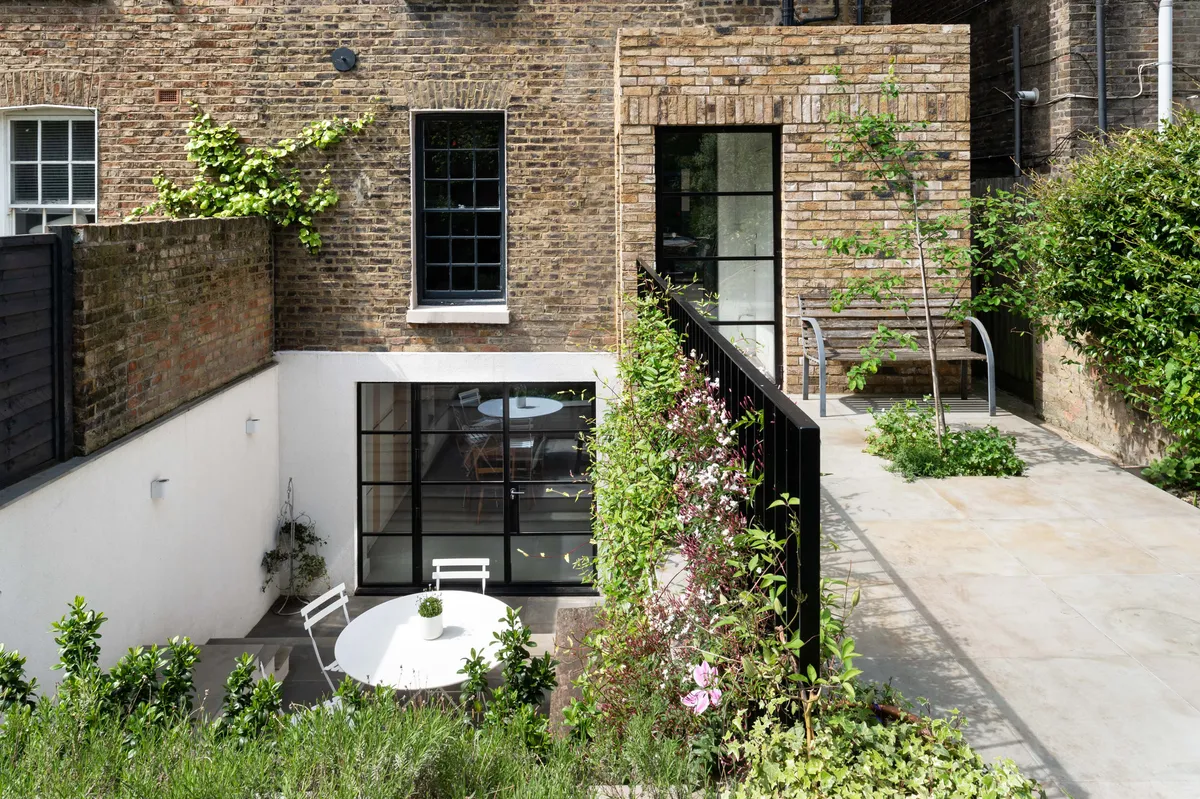
Turning your eye downwards to create new space can be a great idea where plot size is limited or where a loft conversion or rear extension is not possible due to height and size restrictions.
This clever scheme by design practice Paper House Project excavated the ground around an uninhabitable cellar to create a new kitchen. The stepped courtyard and expanded lightwell brings light in, while the addition of a small porch extension was also included to replace the lean-to porch that was previously there.
13. Extend into a garage to improve kerb appeal

In this project, a previously converted garage was largely demolished to make way for a new space designed by Shomera Architecture. The extension added around 8m2 to the front of the house, with a newly constructed bay window and zinc roof that ties into the existing house.
However, you may find your existing garage is already suitable for conversion without requiring demolition. You'll of course need to consider conditions such as thermal efficiency standards for garage conversions and, if you want to extend over a garage, check to make sure the foundations are suitable for carrying the extra load.
14. Introduce luxurious materials to a small extension

Adding pops of interest where a more luxurious or interesting material can work really well with small extensions. As the surface area will be lower, the investment might also not break the bank, unlike a larger space.
"I would certainly advocate for interesting use of material which helps distinguish the new from the old," says Matthew Wood. "Think of your small extension as a precious jewel. It can cost more per sqm than a big extension because it is more fiddly – but that is an opportunity."
The Corten steel metal cladding to this terrace house extension, designed by The Gentleman Architect helps elevate the overall design, making it an obviously modern, but still practical small house extension idea.
Before you start finalising your small house extension ideas, we asked our architect experts for their final top tips to help avoid making extension mistakes.
"Treating a small extension as a purely budget-led exercise or tick box (adding a downstairs loo for example), is a common mistake," says Matthew Wood. "Poor light, awkward proportions, or unresolved connections to the existing house are also very hard to fix later and often undermine the value of the work."
"A common mistake is certainly to treat an extension as separate to the rest of the house, in terms of materials or use, rather than integrating it fully into a redesign of the whole floor of the house," agrees William Tozer.
"An entirely glass-roofed extension will feel very small if the rest of that floor of the house has a plastered ceiling for example, whereas making the threshold between old and new seamless will make the resulting space feel much more generous.
"We would also advise homeowners considering extensions to work with an architect, rather than going straight to a builder," he adds, "as the best solution is different for every house and client, and architects are best placed to tailor a design to those needs."

