
There's a closed church for sale an hour from where I live that I've looked at online 10 times (and counting). It's got a vaulted ceiling and original stained glass. What it also has is no heating, no kitchen, and its very own graveyard. Yet somehow, none of that stopped me dreaming.
So I did what any sane person would do and called the experts. What they told me was fascinating, occasionally alarming, and not entirely what I wanted to hear.
If you share my dream of one day living in a church conversion, read on – but don't say I didn't warn you...
1. The price tag is only the beginning

The first thing Nigel Walter, the founding director of Archangel Architects, says to me is the thing I least want to hear. "You cannot possibly look at an opportunity only in terms of price," he explains. "You've got to look at it in terms of overall costs. These buildings may be concealing huge amounts of expense which will destroy your budget if you're not careful." As I listen, I think about the listing I've had open in another tab for three weeks and say nothing.
The costs Nigel describes aren't only structural – the design challenges add a further layer that buyers consistently underestimate. Stefania D'Amato, architect at Palmer + Partners, has worked on church conversions and seen the gap between vision and reality widen in real time.
"These are very complicated buildings to convert because they were originally designed for such a different use," she tells me. "A huge amount of time and focus at the design stage is required to ensure you create a home that is practical and above all homely."
Both experts are clear: the vision in your head is likely achievable, but it will cost considerably more than the asking price suggests.

Nigel Walter is founding director of Archangel Architects, a Specialist Conservation Architect, RIBA Fellow, and DCMS-nominated member of the Church Buildings Council, with over 30 years' experience working with historic ecclesiastical buildings.

Stefania D'Amato is a RIBA Part 3 Architect at Palmer + Partners, an Oxford-based residential practice specialising in bespoke, sustainable design including barn and church conversions.
2. The buying process can be complicated
The next reality check I received was that the process of buying a closed church or chapel bears almost no resemblance to a conventional property purchase.
If you're planning on purchasing directly from the Church of England rather than a chapel conversion listed on the likes of Rightmove, understand you're not making an offer to a vendor, you're submitting a proposal to a Diocese, which passes it to the Church Commissioners, who open it to a 28-day public consultation during which anyone can formally object to your plans. Only once planning permission and listed building consent have been granted can contracts be exchanged.
I had assumed buying a church to convert would be complicated. I hadn't anticipated it being quite this complicated...
3. Non-Anglican chapels may be the best option
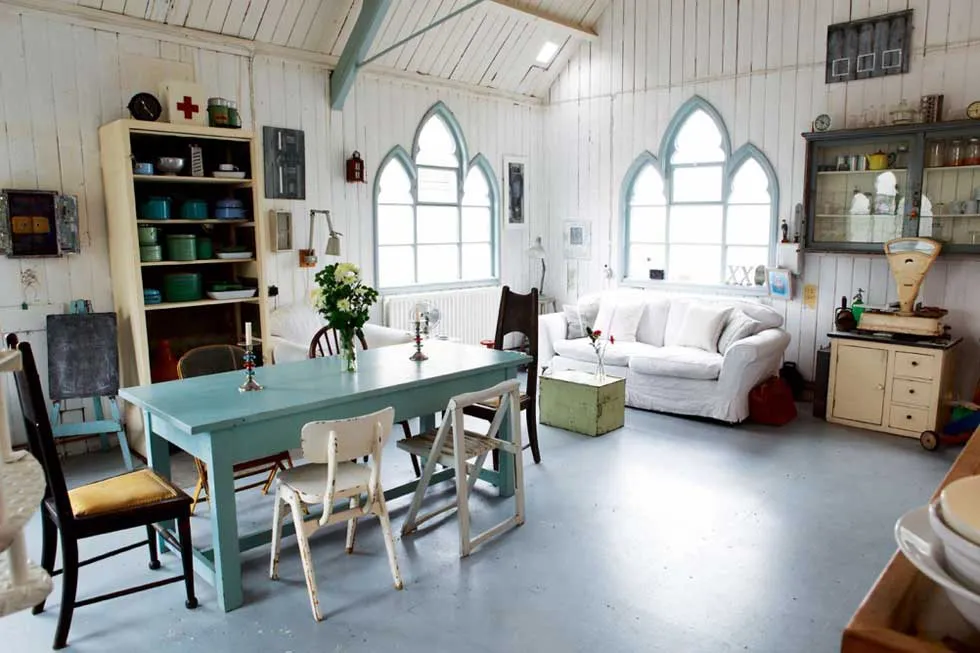
Before you let the buying process put you off entirely, here's something worth knowing: the Church of England's stock of closed buildings isn't necessarily where your search should start and end.
Nigel Walter is direct on this: "If you're looking for a church opportunity, there’ll be more scope to change an unlisted or a Grade II-listed building, as opposed to a Grade II* or Grade I," he tells me. Roughly a quarter of the Church of England's 16,000 buildings are Grade I – the highest and most restricted listing grade – which means far more constraints on what you can do and far more scrutiny on every decision you make.
Baptist and Methodist chapels, by contrast, are rarely listed above Grade II, giving you considerably more flexibility to work with. They're also typically sold through standard estate agents rather than via the Church process described above, which simplifies the purchase. "The ideal building – to get a good house out of an old church – is one that's not too precious on the inside," says Nigel. "Some interest, of course, but not too much heritage value."
4. Planning can be a bit of a lottery
Once a church closes, the Ecclesiastical Exemption – the system that allows denominations to manage listed building consent themselves – falls away entirely, and the local planning authority takes over. You might assume that makes things simpler, but it doesn't.
"The secular planning system around churches can be hugely variable," says Nigel Walter. "It's much more of a lottery." The reason, he explains, is that listed building decisions are heavily dependent on the individual conservation officer and attitudes toward former places of worship can vary enormously from one authority to the next.
"There's a sort of secular nostalgia for the sacred around church buildings," he says. "People still want you to keep your hands off them." His advice is unambiguous: do a pre-application consultation with the conservation officer before you've fully committed to a purchase. Establishing what is actually achievable with a specific building, in a specific area, with a specific officer could save you a very expensive mistake.
5. But there's one thing that could work in your favour
According to Nigel, the Church Commissioners will sometimes obtain outline or even detailed planning permission before putting a building on the market, because having consent in place increases the sale value.
"It's quite common," he explains, "as it's a sensible thing for the seller to do." In practice this means some opportunities will come with at least some of the planning groundwork already done – significantly reducing the risk and upfront professional costs you'd otherwise be absorbing before exchange.
Whether those permissions align with your vision is, of course, another matter entirely, but it's a considerably better starting point than beginning from scratch.
6. The building will surprise you – and surprises can cost money

Even once you've navigated the purchase, the building itself may have a few surprises in store. "These buildings were not designed to be homes," Nigel reminds me. "They were designed for occasional communal use, and the structural and practical implications of that run a lot deeper than most buyers expect."
That means all sorts of challenges can crop up, from thick stone walls with no damp proof course to shallow foundations, complex roof geometry and no existing drainage or services to speak of. None of these are dealbreakers, but all of them cost money to address and most won't reveal their full extent until work begins.
7. It's safe to assume there are bats
If you're looking at a rural chapel, you should assume there are bats. It's not a remote possibility; it's highly likely. "All the barns have been taken down where they used to live," says Nigel, "and they've congregated in the church as a sort of 'last appropriate building standing'."
Bats are legally protected, and their presence has real consequences for your timeline and budget. A preliminary ecological assessment will be required as part of the planning process, and if evidence of bats is found – or even suspected – a full bat survey will need to follow. Those surveys can only be conducted during certain months of the year and are typically only valid for around twelve months. On a project where the process drags on – which church conversions routinely do – you can find yourself commissioning the survey twice at significant additional cost.
8. The graveyard doesn't just go away
When I first looked at that church an hour from my house, I'll be honest, I thought the graveyard added to the romance of the place. I'm now looking at it rather differently. If a church comes with an attached burial ground – and many do – the legal obligations transfer with the building, and covenants attached to the sale will typically require you to allow public access to tend or visit graves at agreed times. The churchyard is not yours to fence off, build on, or landscape over, and that's usually written into the sale documents before you even exchange.
And it can go even further than that. Having downloaded the Church of England's Guidance for Purchasers and Lessees on Acquiring a Closed Church Building, I discovered that if your plans involve any ground disturbance near burials, the Ministry of Justice must be consulted.
Human remains cannot be disturbed without a licence, and obtaining one requires detailed service routing plans, confirmation from utility companies, and potentially bore-hole tests between exchange and completion. If your proposals won't disturb the burials at all, a Home Office exemption can be applied for, but even that takes time and documentation.
9. Making it feel like a home is harder than it looks

According to the experts, the space that makes a chapel so breathtaking to walk into is also the space that makes it so difficult to live in. "We look to introduce structures within these spaces using split levels, joinery and carefully positioned interventions like mezzanines," says Stefania D'Amato, "so you can create distinct living zones while still retaining that sense of height and drama.
"Done well, this approach allows you to frame original features such as arched windows, trusses and large glazed openings rather than cutting across them – which is often a mistake in initial schemes."
Nigel Walter echoes this point from a planning perspective. "The amount of subdivision you can do is constrained," he warns me. "You almost never have roof windows in listed churches – so how you get light into rooms is quite a tricky thing if you're not going to change the external appearance of the building."
The implication is significant: the soaring windows I fell in love with were designed to flood a communal space with light, not to serve individual bedrooms. Working with that rather than against it is the central design challenge of every church conversion, and it's one that requires a specialist, not a generalist, to solve well.
10. Heating and insulating a breathable historic building is a specialist job
These buildings were designed to be heated occasionally, not continuously – and applying standard domestic logic to them is a costly mistake. "Heating up the air is just a really bad strategy in a vastly tall space with poor air tightness," says Nigel. "Underfloor heating would be what you'd want – but then there's the question of how sensitive the floor is, and whether there are burials underneath."
Radiant heating is another option, delivering warmth directly to the body rather than attempting to heat an enormous volume of air that will simply rise to the roof apex and stay there.
The insulation question is equally nuanced. "This type of building is designed to be breathable," explains Stefania. "Natural insulation materials can be more expensive and require greater thicknesses to achieve the same U-values – but they are fundamental for a building of this nature." Get this wrong and you risk trapping moisture in the fabric, creating problems far more expensive than the materials you saved money on.
According to Nigel, creating a true eco home from a historic church is next to impossible, and Passivhaus standards rarely translate well here. What he recommends instead is a sustainability strategy that works with the building's thermal mass rather than against it. With the right approach, he says, the performance can be surprisingly positive.
The non-negotiable, however, is having the right specialist in your corner. An architect who truly understands ecclesiastical buildings will help you avoid the kind of mistakes that are expensive and entirely preventable.
11. People do pull it off and the results can be extraordinary


By the end of my conversation with Nigel, I'll admit I'm feeling slightly chastened. The church I've been looking at for weeks suddenly feels less like a dream and more like a very expensive lesson waiting to happen. But before I sign off, I ask him the question I've been saving: is it worth it?
"These projects can produce fantastic, unique, wonderful places to live," he says warmly. "I've spent most of our conversation pointing out the problems. But the results, when it's done well, are genuinely special."
The key, he tells me, is going in with your eyes open. The people who pull these projects off successfully are not necessarily the ones with the biggest budgets or the grandest vision. They're the ones who took the time to understand the building, assembled the right specialist team, and approached the whole thing as custodians rather than simply homeowners. They worked with the grain of the building rather than against it, and what they ended up with is unlike anything a new build or a standard home renovation could ever produce.
FAQs
Can I get a standard mortgage on a church conversion?
Not always, and according to John Fraser-Tucker, head of mortgages at Mojo Mortgages, many buyers come unstuck by applying for the wrong product. If the building has no functioning kitchen or bathroom, it won't meet the habitation requirements for a standard residential mortgage.
According to John, what you actually need is bridging finance or a self-build renovation mortgage that releases funds in stages. The solution, he says, is to ask your advisor explicitly for a "Manual Underwriting Specialist" from their panel, and to be upfront from the start about any complicating factors, such as graves on the title or land, Grade I or II listed status, restrictive covenants, or non-standard materials such as flint walls or specialist stone roofing. The most common reason these deals fall through, he stresses, "isn't the borrower's income, it's the legal and structural surprises."

John Fraser-Tucker is Head of Mortgages at Mojo Mortgages, specialising in complex and non-standard property finance, including listed buildings, heritage conversions, and specialist residential lending.
Do you always need a specialist lender for a mortgage on a chapel conversion?
The core problem is comparable properties. If nothing similar has sold nearby in the past 12 to 24 months, John Fraser-Tucker warns that "a surveyor may provide a cautious down-valuation, forcing buyers to find a larger deposit." Compound that with flying freeholds, covenant restrictions, and listed building status, and it's easy to see why high-street banks tend to shy away from chapel conversions. The specialist market, however, is more accommodating.
According to John, some green lenders are "increasingly interested in conversions that repurpose existing structures rather than building new," often offering incentives for projects that meet high EPC standards. Others – such as Market Harborough Building Society, Reliance Bank, and Kingdom Bank – have, in John's words, "deep experience with these buildings" and understand the architectural quirks that a computer-led algorithm at a major bank would simply flag as unacceptable risk.
If you're approaching one of these specialists, they'll want to see an experienced contractor or project manager on the team, a detailed line-by-line schedule of works, and a clear exit strategy for moving from a bridging loan to a standard term mortgage once the Certificate of Habitation is signed off.
How much should I budget as a contingency?
John Fraser-Tucker recommends a contingency of at least 20% (double the standard renovation rule of thumb). Heating a vaulted space or repairing stained glass "isn't a jobbing builder task; it requires specialists," and he says that hidden structural issues, from rot in century-old timber to mandatory archaeology watching briefs during groundworks, have a habit of emerging once work begins. Therefore, his current advice is to budget for the full 20% upfront and treat any later reclaim "as a bonus rather than a necessity."
Looking for some first hand experience on what it's like to convert a heritage building? Discover the worlds first Net-Zero Passivhaus church conversion and be inspired by our guide to converting a barn.

