
Plasterboarding is a popular choice for walls and ceilings. It can be fixed directly to bare walls and wood frames with little preparation. It's easy to work with, easy to get hold of and relatively inexpensive, especially when compared with wet plastering.
For DIYers, it's much easier to learn than wet plastering, making it an ideal choice for any DIY project. Even if it goes wrong, a sheet of plasterboard is cheap to replace. And even if you're not confident in skimming the plasterboard to finish the job, you would have reduced labour costs by putting up the plasterboard yourself.

Matt Clare is the owner of Gower Plastering Services, a South Wales plastering contractor with over 15 years’ experience delivering internal and external plastering work for residential and commercial properties.
Shop these plasterboarding products

This everyday plasterboard is available in two standard thicknesses (9.5mm and 12.5mm). It measures 2.4m x 1.2m, is easy to cut and install with screws or nails.

This plasterboard features a high-density core structure that provides enhanced sound insulation and helps meet UK building regulations for acoustic performance.

A set of three skimming blades made from durable ABS plastic with a flexible stainless steel blade to smooth out plaster. Includes 25cm, 40cm and 60mm blades and an extension pole.

Mark has over 20 years of experience in the building sector, leading to a wealth of knowledge surrounding building and renovating that he enjoys sharing with others who are looking to complete their own building projects.
Advantages of plasterboarding
Plasterboarding brings a host of advantages over the more traditional solid plastering; these include speed and ease of installation, quicker drying times, and the availability of labour. Its a common method when building a partition wall or stud wall.
Typically found in older homes, solid plastering is a skill that takes longer to learn and master. And as you might expect, it involves more work than plasterboarding.
Here we take a closer look at the pros and reveal what plasterboarding can bring to DIYers.
Speed of installation
If plastering onto brickwork using plasterboard is a much quicker option, it can take hours rather than days.
Matt Clare, owner of Gower Plastering Services, says, “Plasterboarding is significantly faster than traditional plastering because boards can be fixed using methods like dot and dab or mechanical fixing, then skimmed straight away.”
The dot-and-dab technique means you can get standard flat wall plasterboarded in less than an hour for the more skilled DIYer. It's also an easier technique for those new to plasterboarding.
While dot-and-dab is the preferred method for installing plasterboard to brickwork, it is not the ideal choice for attaching plasterboard to a ceiling. The adhesive isn’t strong enough to keep the plasterboard on the ceiling, so you need to attach it to a wood or metal frame. Check out our how to plasterboard a ceiling guide for more in-depth information on the process.
Ease of installation
“Putting up plasterboard is far less labour-intensive and easier to install”, says Matt Clare. You fix the plasterboard to a wall or frame to create the base for plastering. A common size for plasterboard is 1.2m x 2.4m, so typically you only need three boards to create a single wall.
Mark Irving, building specialist at Build & Plumb adds, “Plasterboard sheets are manufactured flat for consistency, allowing installers to achieve a smooth and even wall surface much quicker than with traditional plastering techniques.”
There isn’t much work involved in putting up a plasterboard sheet. You need to put them in place and use drywall or plasterboard screws, such as these Diall Phillips Bugle Carbon steel Plasterboard screw from B&Q to attach them. Cutting plasterboard is quick and easy, typically involving a sharp knife, a straight line, and a little bending.
Drying times
Compared with traditional plastering, skimmed plasterboard dries much quicker, shares Clare, “Once skimmed, plasterboard dries much quicker than solid plaster, meaning rooms can be decorated sooner.”
Finishing plaster, which provides the final smooth pinky-brown layer you see on newly plastered walls, is touch-dry in 1.5 to 4 hours and cured in about 3-10 days. But it dries and cures even quicker on skimmed plasterboard.
Take a look at our ‘How long does plaster take to dry’ guide for a more in-depth look at setting times and what can affect them.
How to install plasterboard on walls
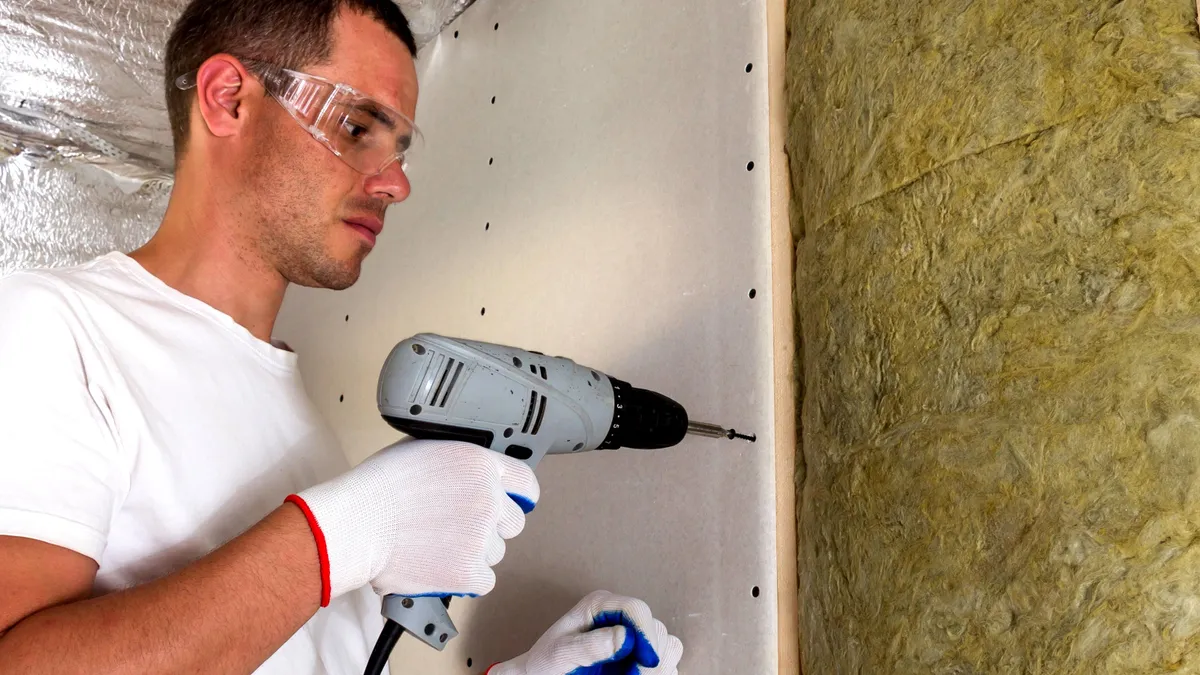
Screws or nails are the two common options for installing plasterboard onto a frame. However, the pros have a preferred choice as Matt Clare, owner of Gower Plastering Services, shares, “Screwing plasterboard is generally better because it provides a stronger and more secure fixing.” He adds, “Drywall screws are designed to grip the timber or metal stud properly and reduce movement.”
Irving explains what screws are used on timber frames: “Most plasterboards are fixed using coarse-thread drywall screws if they are being fixed to timber studs and are typically 32-50mm long, depending on the thickness of the board, which can easily be fitted using a drill or a drywall screw gun.”
Clare adds that nails are still used, but not the preferred choice: “Nails can work, but screws are now the industry standard because they minimise the risk of boards loosening or cracking later.”
FAQs
Is plasterboarding cheaper than plastering?
Plasterboarding and plastering typically go hand in hand, but if you are comparing putting up and skimming plasterboard, then the costs will differ.
Clare points out why it is cheaper, “In most cases, plasterboarding is cheaper because it requires less labour time.” He adds, “Skimming plasterboard is a relatively quick process, whereas traditional plastering onto brick or block walls involves multiple coats and longer drying times, which increases labour costs.”
Putting up plasterboard and plastering are also jobs a competent DIYer can do themselves, saving on labour costs. A plasterer will charge around £200-£250 a day.
Solid plastering involves more know-how and skills and isn’t as easy to pick up as putting up plasterboard and skimming, so you would need to call in a professional to get the job done, and it will typically take twice as long as plasterboarding.
Can I paint straight onto plasterboard?
Yes. You can paint straight onto plasterboard. General-purpose plasterboard is made up of a layer of gypsum – a type of plaster – between two sheets of paper. So it is like painting onto wallpaper, but there are a few points to note.
You need to consider where the plasterboard is located. Standard plasterboard is not waterproof, so it’s not suitable for areas such as kitchens and bathrooms where moisture and water exist. You will also need to cover joints with tape and plaster, and, in some cases, you’ll need to use a primer to prepare the surface.
Plasterboarding is a simple, quick, and effective way to get a wall up quickly and is typically skimmed with gypsum plaster, but other types of plaster can be used. If you are going to have new plaster its wise to know how long it takes to plaster a room so you can plan ahead. If not doing the job yourself, find out how much it costs to plaster a room.

