
Drilling into tiles isn’t difficult, but it needs to be done the right way. Get it wrong, and the drill bit can slip and ruin a tile. Alternatively, a poorly drilled hole will leave you with chips and cracks that are hard to hide. Then there’s the scenario of drilling a perfect hole but in the wrong place.
No one wants to make a mistake, so you need to arm yourself with one of the best cordless drills, the right drill bits, a few other supplies and the expert tips and know-how you’ll find in the guide.

Mark has over 20 years of experience in the building sector, leading to a wealth of knowledge surrounding building and renovating that he enjoys sharing with others who are looking to complete their own building projects.
Choosing the right bit to drill into tile
Ceramic, porcelain and natural stone tiles are popular choices for walls and floors. And drilling into each requires the right drill bit to get a good finish.
For softer ceramic tiles, carbide-tipped drill bits are the budget-friendly option. Mark Irving, building specialist at Build & Plumb, offers the following advice: ”If you are working with ceramic tiles, use a tungsten carbide tip, which has a spearhead shape to reduce chipping.”
He adds, “It is important, however, to never use a tungsten tip when working with porcelain, as this will ruin the tiles significantly.”
Irving suggests an alternative to carbide-tipped drill bits, “A standard masonry drill bit will work fine for softer ceramic tiles, but it is not ideal, as it may cause chipping.”
However, to ensure the best finish, Irving says a specialist drill bit is the best option: “I would recommend using a specialist tile drill bit. Specialist tile drill bits typically have a diamond tip, designed to cut through the hard glaze of a tile without cracking it, and are most useful for porcelain tiles.”

Avoid worn out drill bits that have been well-used for better results. This means that you’ll need to keep an eye on your drill bit while using it too. For the average homeowner drilling into tiles, one drill bit should do your job fine, but professional tilers may have to use multiple drill bits across a job, with a relatively high cost per hole of drilling into tile.
Regardless of the drill bit you use, drilling into tile will require a bit of elbow grease on your part, so be prepared for that.
Shop these tools to help drill into tile

This Vitrex drill bit has a tungsten carbide tip. The precision 'spear head' design prevents chipping or breaking when drilling. Comes with a one-year guarantee.

These diamond-tipped drill bits feature triangular shanks for secure grip and strong bit retention. Available in 25 sizes, they are ideal for ceramic tiles, granite, marble, and masonry.

A cordless impact drill set that has everything you need. Includes 2 x 2.0Ah batteries, 1 x battery charger and a selection of socket drill bits, masonry drill bits, wood drill bits and HSS drill bits.
Use a regular drill to drill into tile
Elbow grease doesn’t necessarily translate into a high-powered drill when drilling into tile. A standard cordless drill might be your best choice for the job in order to avoid cracking the tile.
Should you use the hammer function when drilling into tile? This is a definite no, explains Irving, “When drilling, always do so at a slow speed, avoiding any hammer action to prevent chips or cracking.”
Before you start, make sure your drill is set to its standard drill mode. Irving offers a simple tip to help the drilling process: “Keep your drill bit cool with water to improve your accuracy when drilling.”

Scott Godfrey is a carpenter with over 20 years of experience in the trade. He has extensive experience in both bespoke and large-scale projects, including luxury home builds and renovations.
How to drill into tile
We’re using an example of a diamond tipped drill bit and a porcelain tile for this purpose, but largely the technique is the same for carbide drill bits and ceramic tiles.
1. Measure and mark drill holes
First up, you'll need to measure and mark out where you want to drill the hole. As part of this, it's important to use a wall detector, not only to find out where the studs are (if hanging something on a timber frame wall), but also to ensure there are no cables or pipes behind the wall that you may damage.
2. Get a catch on the tile surface
One of the biggest challenges when drilling into tile is getting a catch on the surface, particularly important when drilling tiles with a glossy surface. Scott Godfrey, carpenter and construction trade consultant for Black Hammer, points out how to get started: "Start the drill slowly, often with the hole saw tipped slightly to create a shallow crescent first, then level out once it has a groove to follow."
He continues, "Run at low speed, keep it cool with water, and let the diamonds do the work rather than forcing it."

Alteratively place a piece of masking tape on the tile and drill into that. This will help give you a better surface to grip your drill bit on to start.

You can also buy drill bit guides for tiles that give you an easy and efficient way to stop your drill bit from slipping when drilling into tiles.
3. Cool the drill bit
Once you're ready to drill through the tile, you'll need to have a way to cool down the drill bit. This is because the tile surface is very hard, and drilling into it will heat up the drill bit, which can cause both your drill to overheat and the bit to not drill any further.
For professionals drilling lots of holes into tiles, there are cooling systems designed for this, however, handily for DIYers, all you really need is a wet sponge. Simply hold above and squeeze water slowly onto the bit while drilling, or you can hold the sponge directly against the drill bit, whichever you prefer.
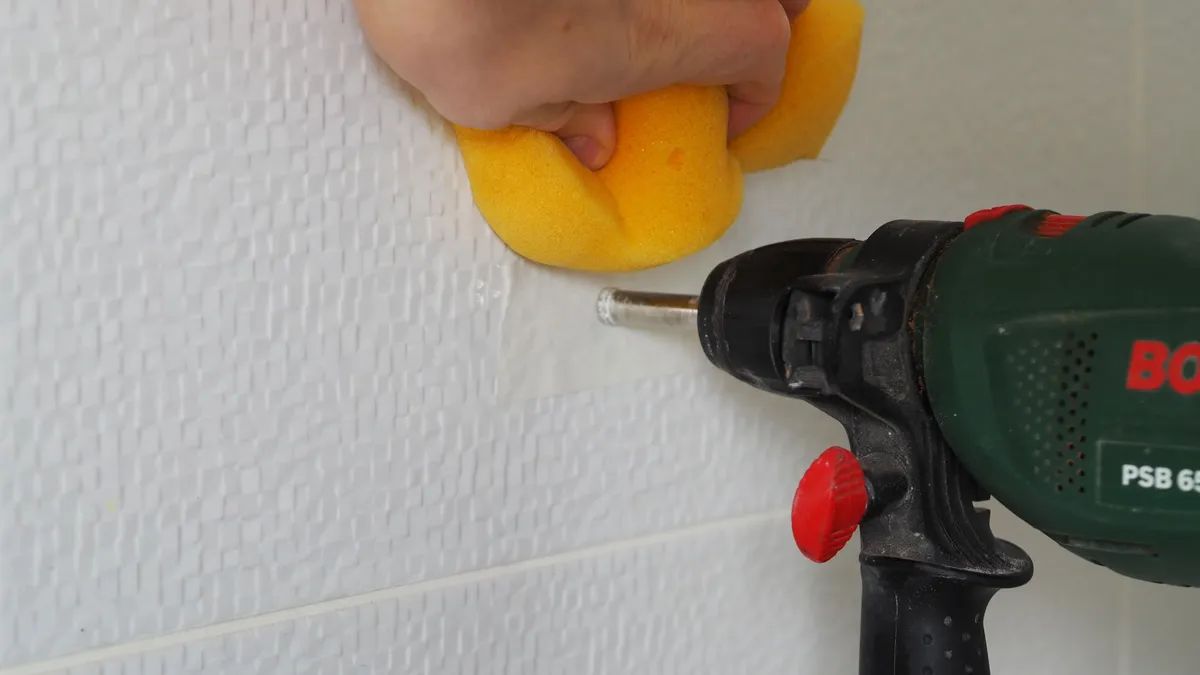
4. Change the drill bit when through tile
Once you've drilled through the tile itself, you'll want to change the drill bit for whatever the wall behind the tiles is. Whether it's a brick wall or timber joists, choose a drill bit accordingly.
How do I drill larger holes into tiles?
There are several methods making larger holes in tiles, from drilling with a diamond tipped hole saw, to cutting a hole with an angle grinder fitted with an appropriate blade.
A diamond hole saw is likely to be the most efficient method for cutting holes for pipes, and is used in the same way as smaller diamond drill bits.

When drilling into tile, you need the right type of drill and the right type of drill bits. But you’ll also need a selection of tools to finish off any DIY project. As a DIY expert, these are the tools I always buy to make sure I can finish a project properly.

