
Homeowners across England are facing difficulties with spray foam insulation installed in their roofs, with some struggling to sell or remortgage properties as a result.
The insulation, installed as part of the government-funded Green Homes Improvement Scheme (GBIS) and ECO4 energy-efficiency schemes, can be safe when correctly fitted, but faulty installations can cause serious problems.
The government has confirmed that it will not provide direct financial assistance for removal, leaving homeowners to rely on installers, guarantees or dispute resolution schemes.
Problems with spray foam insulation
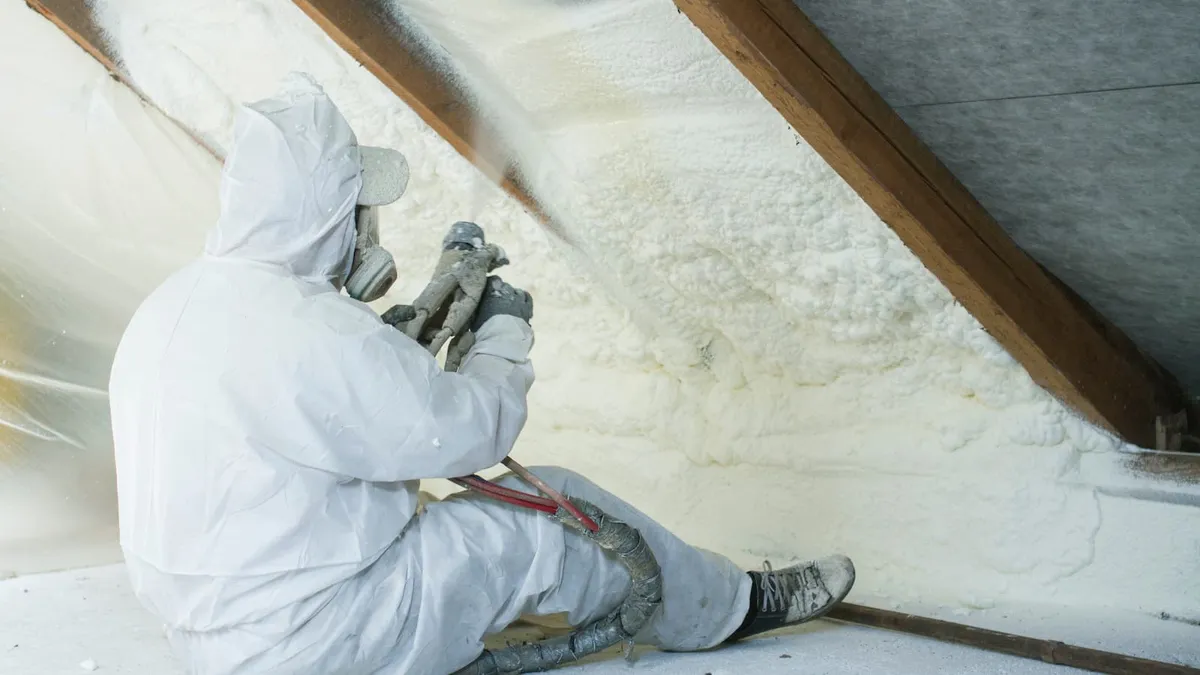
Spray foam insulation is designed to improve a home’s energy efficiency by sealing gaps and reducing heat loss. However, when installed incorrectly, it can trap moisture, cause condensation, and lead to timber decay in roof structures.
These issues have created mortgage and resale problems, with research from the HomeOwners Alliance showing only 25% of mortgage lenders and no equity release providers willing to lend on affected properties.
Costs for removal can also be high – Checkatrade estimates around £3,200 for a typical three-bedroom detached house.
It is important to note that not all spray foam is problematic. Properly installed insulation, following professional standards and product certifications, generally does not pose these risks. The issues primarily arise from faulty or non-compliant installations.
Government schemes and official guidance
The spray foam insulation in question was often installed through GBIS and ECO4, which were government-backed schemes providing financial support for energy-efficiency upgrades.
According to the UK government website, consumers affected by faulty installations are entitled to remediation by the original installer or via an insurance-backed guarantee, but the government will not provide direct financial assistance for removal.
Previous guidance also stresses that homeowners should:
- Keep paperwork from their installation, including test certificates from bodies like the British Board of Agrément (BBA).
- Consult accredited surveyors and professionals to assess whether remedial action is necessary.
This approach aims to ensure that homeowners receive fixes through responsible parties rather than taxpayer-funded programs.
Government response to our enquiry
In a response to an enquiry, officials clarified: “Only a small number of households had spray foam installed through ECO or GBIS. Any household with any measure fitted under GBIS or ECO schemes is entitled to remediation for any non-compliant work (including any spray foam) through the original installer."
They continued: "All measures must have a guarantee, although the length of these guarantees varies by measure and policy. Consumers are encouraged to use certification bodies and TrustMark existing complaints processes, should they need to.”
In other words, the government will not pay for removal, but homeowners with faulty spray foam can pursue remediation via the installer or their insurance-backed guarantee.
Consumer groups, however, say more needs to be done to address the financial impact on homeowners. Paula Higgins, Chief Executive of the HomeOwners Alliance, said: “The ECO4 grant and Great British Insulation Scheme (GBIS) both fund the installation of spray foam to eligible households. It can’t be that homeowners convinced to install spray foam at a significant personal financial cost, and in many cases with help of government grants, are now faced with bills for hundreds if not thousands of pounds to remove the product – far exceeding the original installation costs.”
She added that the government also needs to act on rogue removal firms targeting vulnerable homeowners: “We also call on the government’s assistance to stamp out the rogue spray foam removal companies who are scaring homeowners to remove the insulation and are causing even further damage to their homes.”
For now, homeowners with problematic spray foam face costly removals, difficulties remortgaging, potential condensation issues, and no direct government funding – even though the installations were encouraged through government schemes.

